

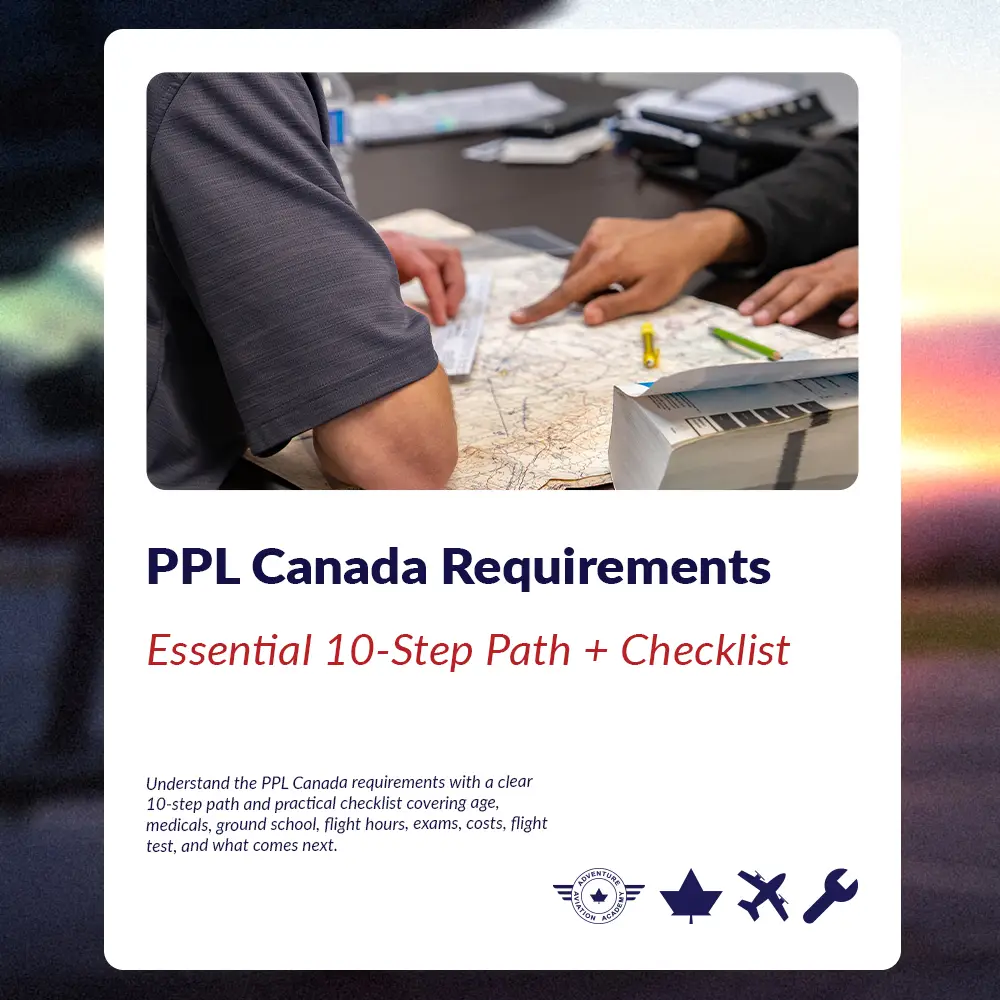
If you are researching PPL Canada requirements, the process can seem like a long list at first.
To earn a Private Pilot Licence – Aeroplane in Canada, you must be at least 17 years old, meet the required medical standard, complete at least 40 hours of ground school, pass the PPAER written examination, complete at least 45 hours of flight training, and pass your flight test.
Along the way, you will also work through your Student Pilot Permit, radio certification, aviation language requirements, solo flying, cross-country training, and instrument training.
As instructors, we find it is much more useful to think about these requirements as milestones rather than one large checklist.
For example, you can start learning to fly before age 17. You can also become eligible to attempt your flight test before completing the full 45-hour minimum required for licence issuance.
Likewise, some requirements happen at the same time. You might be working through ground school while also learning aircraft handling, preparing for your first solo, and building the experience required for your written examination.
In this guide, we will walk you through the process in the order you are likely to experience it.
For regulatory requirements, we rely on Transport Canada Standard 421 and the Canadian Aviation Regulations.
When we discuss our own training structure, course costs, aircraft time, or other Adventure Aviation details, we are referring to our current Private Pilot Licence training program.
PPL Canada Requirements at a Glance
To earn a Canadian Private Pilot Licence – Aeroplane, you need to meet requirements for age, medical fitness, knowledge, flight experience, and flying skill.
These PPL Canada requirements cover the five main areas you need to satisfy: age, medical fitness, knowledge, flight experience, and flying skill.
Here is the basic picture:
| Requirement | Canadian PPL-A requirement |
|---|---|
| Minimum age for PPL issuance | 17 |
| Student Pilot Permit minimum age | 14 |
| Medical for PPL | Category 3 minimum, or valid Category 1 |
| Ground school | Minimum 40 hours |
| Written examination | PPAER |
| PPAER pass standard | 60% overall and at least 60% in each mandatory subject area |
| Minimum total flight training | 45 hours |
| Minimum dual instruction | 17 hours |
| Dual cross-country | Minimum 3 hours |
| Instrument training | Minimum 5 hours |
| Instrument ground time | Maximum 3 of the 5 instrument hours |
| Minimum solo training | 12 hours |
| Solo cross-country | Minimum 5 hours |
| Qualifying solo cross-country | At least 150 nautical miles with 2 full-stop landings away from the departure point |
| Flight test | Successful PPL-A flight test |
| Pre-solo milestone | Student Pilot Permit and instructor authorization |
| Aviation language | Applicable aviation language proficiency requirement |
You can review the complete regulatory requirements in Transport Canada Standard 421.26.
However, there are two numbers we want you to understand right away.
First, 45 hours is the regulatory minimum. It is not a guaranteed completion point.
Second, the minimum 17 dual hours and 12 solo hours do not make up the entire course. Instead, they are minimum categories within the overall 45-hour requirement.
Your goal is not simply to reach a number in your logbook. Your goal is to develop the knowledge, judgment, and flying skill required to operate safely and confidently.
If you want to see how we organize that training, you can also explore our Private Pilot Licence training program.
What Is a Private Pilot Licence in Canada?
A Canadian Private Pilot Licence, commonly shortened to PPL or PPL-A for aeroplanes, allows you to exercise private-pilot privileges in aeroplanes for which you hold the appropriate qualifications and ratings.
In simpler terms, your PPL gives you the ability to fly privately once you have met the applicable licence, aircraft, medical, and recency requirements.
However, it is important to understand that a PPL is not simply a course-completion certificate.
You earn the licence by meeting Transport Canada’s requirements for:
- age
- medical fitness
- aviation knowledge
- flight experience
- flying skill
Once you have your licence, it can become the foundation for much more.
For example, you may decide to continue into:
- a Night Rating
- a Multi-Engine Rating
- an Instrument Rating
- a VFR Over-the-Top Rating
- a Commercial Pilot Licence
On the other hand, you may simply want to fly privately for personal adventure and recreation. That is a perfectly valid path too.
There is also a Recreational Pilot Permit available in Canada. It has different requirements and privileges.
Therefore, before you begin, it is worth thinking about what kind of flying you actually want to do.
If you are still comparing your options, take a look at our Recreational Pilot Permit information as well.
How to Get a PPL in Canada: The 10-Step Path
When we explain the PPL process to a new student, we like to break it into smaller milestones.
Not every step happens in a perfectly straight line. In fact, several will overlap.
Still, this sequence gives you a clear idea of what lies ahead.
1. Explore the Training Path
Your first step is simply understanding what you are getting into.
You do not need to know every regulation before your first flying lesson. Instead, you should understand the basic training path, what the PPL allows you to do, and whether it matches your goals.
For many people, a Discovery Flight is a good place to begin.
Our Discovery Flight gives you the chance to experience flying with an instructor, see the aircraft, ask questions, and get a better sense of what flight training actually feels like.
If you decide to continue into our PPL program, we can also credit that Discovery Flight toward your training.
The easiest way to understand PPL Canada requirements is to put them into the order you will actually encounter them during training.
2. Start Your Aviation Medical
Next, we recommend beginning your aviation medical process early.
Among the PPL Canada requirements, the medical is one we recommend starting early.
Transport Canada requires a Category 3 medical certificate for a Private Pilot Licence – Aeroplane. A valid Category 1 medical also satisfies the requirement.
You can review the applicable requirements in Transport Canada Standard 421.
Starting your medical early gives you a clearer understanding of your eligibility before you invest heavily in training.
That does not mean you need to wait until everything is complete before learning about aviation. However, medical eligibility is an important part of your licensing path, so it should not be left until the very end.
3. Begin Flight Training and Ground School
Once you start training, you will normally work on two things at the same time.
You will learn how to fly, and you will learn why things are done the way they are.
Transport Canada requires at least 40 hours of ground school for the PPL.
Your ground-school subjects include areas such as:
- Air Law
- aerodynamics
- meteorology
- aircraft systems
- flight instruments
- navigation
- flight operations
- human factors
- licensing requirements
At the same time, your flying lessons begin building practical skills.
Early on, that means becoming comfortable in the aircraft, understanding checklists and procedures, learning how the controls affect the aeroplane, and gradually taking on more responsibility.
As your training continues, the ground-school knowledge and flying experience begin to connect.
4. Complete Your Pre-Solo Training
One of the first major milestones in flight training is your first solo.
However, there is no magic number of flying hours that automatically makes someone ready to fly alone.
Before we authorize a student for solo flight, that student needs to demonstrate the required level of skill and meet the applicable regulatory requirements.
That means learning aircraft control, takeoffs, landings, circuit procedures, emergency procedures, radio work, and decision-making to the required standard.
You will also need to meet the Student Pilot Permit requirements.
Therefore, your first solo happens when both sides come together:
You meet the regulatory requirements, and your instructor determines that you are ready.
5. Obtain Your Student Pilot Permit
Your Student Pilot Permit is an important part of the path toward solo flight.
For aeroplanes, the minimum age for a Student Pilot Permit is 14.
Depending on the applicable requirements, medical eligibility at this stage can be supported by the prescribed medical declaration or an appropriate Category 1, 3, or 4 medical certificate.
You can review the Student Pilot Permit requirements within Transport Canada Standard 421.
However, remember that the Student Pilot Permit is not your PPL.
Instead, it is one of the milestones that allows you to progress into solo training once your instructor has determined that you are ready.
6. Complete PSTAR, Radio, and Language Requirements
As you move toward solo flying and licensing, you will encounter several knowledge and communication requirements.
They are easy to mix up, so we like to keep them separate.
PSTAR
PSTAR covers important Canadian aviation regulations and procedures for the Student Pilot Permit stage.
According to Transport Canada’s PSTAR Study and Reference Guide, the examination contains 50 questions.
You need a 90% pass mark. Afterward, incorrect answers are reviewed so the examination is corrected to 100%.
ROC-A
You will also need to understand how to communicate properly over the aircraft radio.
The Restricted Operator Certificate – Aeronautical, or ROC-A, is the radio operator certificate used for aeronautical-band radio operation.
Innovation, Science and Economic Development Canada explains that you obtain the ROC-A by passing an examination administered by an accredited examiner.
You can read more about it through the federal ROC-A information page.
The ROC-A is currently valid for life and does not require renewal.
Aviation Language Proficiency
Aviation language proficiency is another separate requirement.
Transport Canada allows aviation language proficiency to be demonstrated in English and/or French under the applicable framework.
You can read the current requirements in Transport Canada’s Aviation Language Proficiency Demonstration guidance.
So, if all of these acronyms are starting to blur together, remember:
- PSTAR relates to regulations and procedures at the Student Pilot Permit stage.
- ROC-A relates to operating aeronautical radio equipment.
- PPAER is your main PPL written knowledge examination.
- Aviation language proficiency relates to the communication standard required for licensing.
They are all part of becoming a pilot, but they serve different purposes.
7. Write the PPAER Examination
As your ground-school knowledge and flight experience develop, you will work toward the PPAER.
PPAER is Transport Canada’s written examination for the Private Pilot Licence – Aeroplane.
Before you write it, you need to satisfy Transport Canada’s examination prerequisites.
Under the current standard, a PPL applicant must have completed at least five hours of flight time in the same aircraft category before attempting the written examination.
You must also meet the applicable requirements for:
- medical fitness
- identification
- ground-school completion
- instructor recommendation
You can review the complete prerequisites in Transport Canada Standard 421.13.
That five-hour figure is worth noting because older aviation information may still show a different requirement.
8. Build Your Required Flight Experience
While you are working through exams and ground school, your flying continues.
Now your experience begins expanding beyond the basic handling exercises.
You will build:
- dual flight time
- solo flight time
- cross-country experience
- instrument training
- navigation skills
- greater independence in the aircraft
This is where your training begins to feel less like a collection of exercises and more like actually becoming a pilot.
However, remember that we are not simply trying to fill a logbook.
Transport Canada gives us minimum experience requirements. Your training also needs to bring you to the skill level required for the licence.
9. Pass Your PPL Flight Test
Eventually, you will reach the point where your instructor can recommend you for your flight test.
Interestingly, you do not necessarily need to have completed the full 45-hour licence minimum before taking the complete flight test.
Transport Canada allows a PPL applicant to become eligible for the complete flight test after completing at least 35 hours of the required flying experience, provided the other admission requirements are met.
You can review those requirements in the Transport Canada Private Pilot Licence Flight Test Guide.
However, this does not reduce the 45-hour requirement for your licence.
We will explain that distinction in more detail later because it is one of the most commonly misunderstood parts of the PPL process.
10. Complete Your Remaining Licence Requirements
Finally, once your training and flight test are complete, you need to make sure every remaining requirement has been satisfied.
That includes:
- your medical
- ground school
- written examination
- required flight experience
- flight test
- applicable documentation
- licence application requirements
Once everything is complete, you can apply for the licence.
The process may sound complicated when you see every requirement at once. However, when you work through it lesson by lesson, each milestone leads naturally into the next.
How Old Do You Have to Be for a PPL in Canada?
PPL Age Requirement
You must be at least 17 years old to be issued a Canadian Private Pilot Licence – Aeroplane.
However, that does not mean you must wait until 17 to start flying.
You can begin flight training earlier.
As a result, someone who begins training young may already have meaningful flying experience by the time they become old enough for their licence.
Student Pilot Permit and PSTAR
The minimum age for a Student Pilot Permit is 14.
That explains why you may see two different ages when researching Canadian pilot training.
| Milestone | Minimum age |
|---|---|
| Student Pilot Permit | 14 |
| Private Pilot Licence issuance | 17 |
However, age is only one requirement.
Turning 14 does not automatically mean you are ready to solo. Similarly, turning 17 does not automatically qualify you for a PPL.
You still need to meet the applicable medical, knowledge, experience, and skill requirements.
Most importantly, your instructor needs to be satisfied that you can safely conduct your solo flight before authorizing it.
What Medical Do You Need for a PPL in Canada?
For your Canadian PPL-A, you need at least a valid Category 3 medical certificate.
A valid Category 1 medical also satisfies the requirement.
However, you may see Category 4 mentioned while researching flight training.
That is because a Category 4 medical can be relevant at the Student Pilot Permit stage. Nevertheless, it does not satisfy the final PPL medical requirement.
If you are training on a Category 4 medical, you will need to meet the Category 3 medical standard before your PPL can be issued.
A simple way to think about it is:
| Stage | Medical |
|---|---|
| Student Pilot Permit – Aeroplane | Applicable declaration or Category 1, 3, or 4 |
| Private Pilot Licence – Aeroplane | Category 3 minimum, or valid Category 1 |
You can review the applicable requirements through Transport Canada’s flight crew licensing standards.
Medical validity also changes with age.
For PPL privileges, the normal validity period is currently:
- 60 months if you are under 40
- 24 months if you are 40 or older
However, Transport Canada may issue a shorter period depending on individual circumstances.
Because medical eligibility is personal, we recommend starting the process early if you have any concerns.
Do not assume a medical condition automatically prevents you from becoming a pilot. Instead, work through the proper aviation medical process and get an answer based on your own circumstances.
Ground School and the PPAER Written Exam
| Ground School and PPAER section |
| Add near the beginning: “The knowledge side of the PPL Canada requirements includes both ground school and the Transport Canada written examination. |
How Much Ground School Is Required?
Transport Canada requires at least 40 hours of PPL ground school.
During ground school, you build the knowledge that supports the decisions you make in the aircraft.
Your subjects include areas such as:
- Air Law
- Meteorology
- Navigation
- Aerodynamics
- Aircraft systems
- Flight instruments
- Flight operations
- Human factors
- Licensing requirements
At Adventure Aviation, our PPL program also includes 40 hours of ground school.
You can see our current course structure on our Private Pilot Licence page.
We also budget 25 hours of ground briefing separately.
This is an important distinction.
Ground school and ground briefing are not the same thing.
Ground school covers the broader knowledge required for your licence and written examination.
Ground briefings, meanwhile, are connected more directly with your flight lessons, preparation, procedures, exercises, and post-flight learning.
Therefore, our 25-hour ground-briefing figure should not be confused with Transport Canada’s 40-hour ground-school requirement.
What Is the PPAER Exam?
The PPAER is Transport Canada’s written examination for the Private Pilot Licence – Aeroplane.
According to the Transport Canada PPAER Study and Reference Guide, the exam includes:
- 100 multiple-choice questions
- a 3-hour time limit
- a minimum overall mark of 60%
- a minimum of 60% in each mandatory subject area
Those four areas are:
- Air Law
- Navigation
- Meteorology
- Aeronautics – General Knowledge
Therefore, you cannot simply score very well in one area and ignore another. You need the required mark both overall and within each mandatory section.
If your overall result is at least 60% but you do not achieve 60% in one or more mandatory sections, Transport Canada’s rules allow for supplementary examinations in the failed subject areas.
In addition, your written examination has a validity window.
Under CAR 400.03, the required examination generally needs to have been completed within the 24 months before your licence application.
Therefore, we want the PPAER to fit sensibly into your overall training plan rather than treating it as an isolated test.
PPL Canada Requirements for Flight Hours
Of all the PPL Canada requirements, the 45-hour flight-training minimum is probably one of the most misunderstood.
However, simply reaching 45 hours does not automatically mean your training is finished.
Those hours must include specific types of training, and you still need to demonstrate the required level of skill.
Minimum Total Flight Training
The regulatory minimum is 45 hours.
Transport Canada allows a maximum of five of those hours to be completed on an approved aeroplane simulator or flight training device under the applicable requirements.
Still, it is important to understand the word minimum.
Some students may need additional time to reach the required standard.
That is normal.
Your goal is to become a safe and competent pilot, not simply to reach hour 45 as quickly as possible.
Dual Flight Requirements
You need at least 17 hours of dual instruction.
Dual means you are flying with a qualified instructor who is providing training.
Within the applicable training requirements, you need at least:
- 3 hours of dual cross-country training
- 5 hours of instrument training
Instrument training teaches you to control the aircraft by reference to the flight instruments rather than relying entirely on outside visual references.
Of those five instrument hours, no more than three may be instrument ground time.
Solo Flight Requirements
You also need at least 12 hours of solo flight time.
Solo means you are the only person in the aircraft.
Of those 12 hours, at least 5 hours must be solo cross-country flight time.
Your solo training is where you begin taking much more responsibility for the flight.
However, even though you are flying the aeroplane alone, those flights are still part of a structured training program. Your instructor continues to supervise and authorize your solo training.
The 150-Nautical-Mile Solo Cross-Country
One of the major milestones in your solo training is the qualifying cross-country flight.
Transport Canada requires a solo cross-country flight of at least 150 nautical miles.
During that flight, you must complete two full-stop landings at points other than your departure point.
This is where many of the skills you have been learning begin to come together.
You are planning the route, checking weather, navigating, managing fuel, communicating, making decisions, and operating away from your usual training area.
There is no single national route that every PPL student flies. Your route will depend on where you train and the flight plan selected for your training.
Instrument and Simulator Time
This is another requirement we want to make very clear.
Transport Canada requires five hours of instrument time for the PPL.
Of those five hours, no more than three may be completed as instrument ground time.
Our current PPL training structure separately lists three hours of simulator time.
You can see that in our PPL course information.
However, those statements mean different things.
Transport Canada does not say that every Canadian PPL student must complete exactly three simulator hours.
The national requirement is five hours of instrument training, with a maximum of three hours allowed as instrument ground time.
We then use simulator time within our own training structure to help meet the applicable learning objectives.
Keeping those two things separate prevents a lot of confusion.
ROC-A and Aviation Language Requirements
As you progress through training, you will also develop the communication skills needed to operate in the aviation environment.
Do PPL Students Need a Radio Certificate?
The Restricted Operator Certificate – Aeronautical, or ROC-A, is the radio operator certificate used for aeronautical communications.
To receive it, you must pass an examination administered by an accredited examiner.
You can read the federal requirements on the ROC-A information page.
Once issued, the ROC-A is currently valid for life and does not require renewal.
We include ROC-A preparation and requirements within our PPL training path because radio communication quickly becomes part of everyday flying.
At first, radio calls can sound fast and unfamiliar.
However, like most aviation skills, they become much easier once you understand the structure and practise them regularly.
What Is Aviation Language Proficiency?
Canadian aviation licensing also includes an aviation language proficiency requirement.
Transport Canada allows aviation language proficiency to be demonstrated in English and/or French under the applicable system.
You can review Transport Canada’s Aviation Language Proficiency Demonstration guidance.
Again, keep this separate from your other exams.
Your aviation language requirement is not the same thing as PPAER, PSTAR, or ROC-A.
Each measures something different.
What Happens on the PPL Flight Test?
Your flight test is one of the final major milestones in your PPL training.
During the test, you demonstrate that you can perform the required exercises and operate the aircraft to Transport Canada’s standard.
However, there is one distinction we want every student to understand:
You can become eligible to attempt the complete flight test before you have completed the full 45-hour licence minimum.
Transport Canada’s current flight-test prerequisites allow a PPL applicant to attempt the complete test after completing at least 35 hours of the required flying experience, provided the other admission requirements are satisfied.
Before the test, you will also need the applicable:
- identification
- medical evidence
- permit or licence documentation
- instructor recommendation
- flight-experience evidence
Your instructor recommendation confirms that your training and pre-test evaluation have been completed and that you are considered ready for the test.
You can see the complete requirements in Transport Canada’s Private Pilot Licence Flight Test Guide.
The minimum overall passing score is currently 62 points, or 50%.
However, individual exercises matter too. Therefore, the test is not simply a matter of collecting enough total points while disregarding an unacceptable performance on an individual item.
Most importantly, remember this:
35 hours can satisfy the minimum experience requirement for attempting the complete flight test.
45 hours remains the minimum flight-training requirement for licence issuance.
So, even if you pass your flight test before reaching 45 hours, you still need to complete the remaining licensing requirements.
Your successful PPL flight test must also fall within the applicable licence-application window.
How Much Does a Private Pilot Licence Cost in Canada?
Cost is understandably one of the biggest questions future pilots ask us.
Although cost is not itself one of the PPL Canada requirements set by Transport Canada, it is an important part of planning your training.
At Adventure Aviation, our current minimum-course estimate is $19,822.
However, we also state that most Canadian students should expect a total PPL investment of approximately $25,000 to $27,000.
These figures describe two different things.
Our $19,822 estimate is based on the minimum-course structure we currently publish.
It is not a guaranteed final price.
Our Current PPL Cost Breakdown
Our current published PPL estimate includes:
| Component | Published amount |
|---|---|
| 33 hr Cessna 172 Dual | $11,434.50 |
| 12 hr Cessna 172 Solo | $3,465.00 |
| 40 hr Ground School | $600.00 |
| 25 hr Ground Briefing | $2,362.50 |
| Flight Test Fee | $650.00 |
| PPL Books | $500.00 |
| TC Written Exam Fee | $315.00 |
| Licensing and Doc Fee | $495.00 |
| Total | $19,822.00 |
Our published estimate is based on minimum-hour requirements and is subject to change.
Therefore, if you are budgeting for training, always check our current flight training costs before making your final plan.
Why Do We Budget 33 Dual Hours?
You may notice something interesting in our cost table.
Transport Canada’s national minimum is 17 hours of dual instruction.
However, our minimum-course budget uses 33 hours of Cessna 172 dual time and 12 hours solo.
Together, those figures create the 45 hours of aircraft time used in our published minimum-course estimate.
Therefore, the 33 dual hours in our budget should not be mistaken for a Transport Canada regulatory minimum.
It is part of our course structure and budgeting model.
This is a good example of why regulatory requirements and flight-school training plans should always be kept separate.
Why Can the Final Cost Be Higher?
Every student learns at a different pace.
As a result, your final cost may increase if you need additional:
- dual instruction
- solo practice
- aircraft time
- ground briefing
- review
- preparation before the flight test
Training frequency can also make a difference.
For example, longer gaps between lessons may mean spending some time reviewing skills you learned previously.
Weather and scheduling can affect training as well.
However, needing additional training is not a failure.
The goal is not to finish in the fewest possible hours. The goal is to become the pilot you need to be before exercising the privileges of the licence.
Government Fees Versus Our Course Budget
Our published cost table currently includes a $315 TC Written Exam Fee line and a $495 Licensing and Doc Fee line.
Those amounts are part of our published course budget.
Therefore, we recommend treating them as budget items within our training estimate rather than assuming the full amount of each line represents a direct federal government charge.
If you want the latest cost information before starting, check our Flight Training Costs page or talk with us directly.
How Long Does It Take to Get a PPL in Canada?
There is no Transport Canada rule saying that everyone must finish a PPL within a particular number of weeks or months.
Instead, the regulations define what you need to know, what experience you need to build, and what level of skill you need to demonstrate.
Your actual timeline can depend on:
- how often you train
- your availability
- weather
- aircraft availability
- instructor availability
- your progress through ground school
- your medical
- examination scheduling
- your learning pace
- how much review you need between lessons
Consistency can make a real difference.
For example, if you fly regularly, your previous lesson may still feel fresh when you arrive for the next one.
On the other hand, if several weeks pass between lessons, you may need to spend part of the next flight reviewing skills before moving forward.
Therefore, instead of focusing only on:
“How quickly can I finish?”
we encourage students to think about:
“How consistently can I train?”
That question is often much more useful when planning your PPL.
We also avoid promising a universal completion timeline because every student’s circumstances are different.
What Can You Do With a Canadian PPL?
Once you earn your PPL, you can exercise private-pilot privileges within the limits of your licence, ratings, aircraft qualifications, medical, and recency.
Under CAR 401.26, a Private Pilot Licence – Aeroplane holder may act as pilot-in-command or co-pilot of an aeroplane of a class and type for which the appropriate ratings are held.
For many pilots, that means personal and recreational flying.
However, your PPL can also become the starting point for much more.
You may choose to:
- carry passengers when the applicable requirements are met
- build more flying experience
- add a Night Rating
- train on multi-engine aircraft
- earn an Instrument Rating
- work toward your Commercial Pilot Licence
The important thing is that your PPL creates options.
What you do next depends on where you want flying to take you.
What Are the Restrictions on a Canadian PPL?
Your PPL gives you significant private-flying privileges.
However, it does not automatically allow every type of operation.
Can a Private Pilot Be Paid?
A Private Pilot Licence is generally not a licence for flying for hire or reward.
However, it is also too broad to say that a private pilot can never receive reimbursement.
CAR 401.28 provides specific situations where reimbursement may be permitted.
For example, certain passenger cost-sharing arrangements can allow the reimbursement of applicable fuel, oil, and aircraft fees when the regulatory conditions are met.
You can review those provisions in CAR 401.28.
If your goal is to get paid to fly professionally, then your training path changes.
In that case, you will want to look at our Commercial Pilot Licence training.
Can You Carry Passengers?
Yes, a qualified private pilot can carry passengers when the applicable requirements are met.
However, you also need to remain current.
Under CAR 401.05, passenger carrying includes a six-month takeoff-and-landing recency requirement.
You can review the current rule in CAR 401.05.
Therefore, having your PPL is only part of the equation.
You also need to make sure you are current for the flight you plan to make.
Can You Fly at Night With a PPL?
Not automatically.
A basic PPL does not include night privileges by itself.
To exercise the applicable privileges at night, you need a Night Rating.
Therefore, if night flying is something you want to do, that can become one of your next training steps after earning your PPL.
You can learn more about our Night Rating training.
Does a Canadian PPL Expire?
We usually encourage pilots to think about this question a little differently.
Instead of asking whether the PPL itself simply “expires,” think about four separate things:
- your licence
- your medical
- your ratings
- your recency
Even if you hold a PPL, you still need to meet the applicable medical and recency requirements before exercising its privileges.
Three time periods are particularly useful to remember:
| Requirement | Key period |
|---|---|
| General pilot recency | 5 years |
| Recurrent training | 24 months |
| Passenger takeoff and landing recency | 6 months |
Under CAR 401.05, Canadian pilots need to satisfy the applicable five-year and 24-month recency requirements.
In addition, carrying passengers has its own shorter recency requirement.
Your medical follows a separate timeline.
For normal PPL privileges, the medical validity period is currently generally:
- 60 months if you are under 40
- 24 months if you are 40 or older
However, an individual medical certificate may have a shorter validity period.
Therefore, once you become a pilot, the practical question is not simply:
“Do I still have my licence?”
Instead, ask:
“Am I medically valid, properly rated, and current for the flight I want to make?”
That is a much better way to think like a pilot.
What Comes After a Private Pilot Licence?
Once you have your PPL, the next step depends entirely on the type of flying you want to do.
You do not need every rating.
Instead, choose the training that supports your goals.
Night Rating
If you want to expand into night flying, a Night Rating is a natural next step.
Our Night Rating training helps PPL holders build the knowledge and experience needed for the applicable night privileges.
Multi-Engine Rating
If you want to fly qualifying aeroplanes with more than one engine, you can continue into multi-engine training.
We offer Multi-Engine Rating training for pilots who want to develop those skills.
Instrument Rating
An Instrument Rating is the path toward exercising IFR privileges when the applicable requirements are met.
If instrument flying is part of your goals, explore our Instrument Rating training.
VFR Over-the-Top Rating
A VFR Over-the-Top Rating adds privileges for qualifying VFR OTT operations.
We also offer VFR Over-the-Top training for pilots who want to expand their capabilities in that direction.
Commercial Pilot Licence
If you want flying to become a career, your PPL can become the foundation for commercial training.
A Commercial Pilot Licence has additional medical, knowledge, experience, and skill requirements.
Therefore, the PPL is not the end of the path for a career pilot. It is one of the major building blocks.
You can explore our Commercial Pilot Licence training when you are ready to start planning that next stage.
Your PPL Canada Requirements Checklist
If you want the entire path in one place, here is a simple checklist you can follow:
- Learn what the Private Pilot Licence allows you to do
- Decide whether a PPL fits your goals
- Consider taking a Discovery Flight
- Begin your aviation medical
- Start flight training
- Start ground school
- Complete at least 40 hours of ground school
- Meet the Student Pilot Permit requirements
- Complete PSTAR
- Obtain your Student Pilot Permit
- Reach the required standard for instructor-authorized solo flight
- Complete ROC-A requirements
- Meet the applicable aviation language proficiency requirement
- Meet the prerequisites for the PPAER
- Pass the PPAER written examination
- Complete the required dual training
- Complete the required solo training
- Complete the required cross-country training
- Complete the required instrument training
- Complete your 150-nautical-mile solo cross-country
- Meet the flight-test prerequisites
- Receive your instructor recommendation
- Pass your PPL flight test
- Complete the full 45-hour minimum and all remaining experience requirements
- Complete your licence application requirements
That may still look like a lot on one page.
However, remember that you do not complete it all at once.
Your first lesson leads to the next lesson.
Your first circuit leads toward your first solo.
Your first solo leads toward cross-country flying.
Eventually, those individual milestones add up to something much bigger.
You become a pilot.
Ready to Take the First Step?
By now, you should have a much clearer picture of the PPL Canada requirements.
There are regulations to meet, exams to complete, skills to learn, and hours to build.
However, you do not need to know everything before you begin.
That is what your training is for.
If you are still deciding whether becoming a pilot is right for you, start by experiencing it.
Our Discovery Flight gives you the opportunity to get into the aircraft with an instructor, take part in the flight, ask questions, and see what flight training actually feels like.
If you decide to continue with us, we can credit that Discovery Flight toward your PPL training.
We provide flight training from our locations in Grande Prairie, Alberta, and Fort St. John, British Columbia.
If you already know you are ready to begin, you can also contact us and start your enrolment.
You do not need to arrive knowing how to be a pilot.
That is what we are here to teach you.
You bring the curiosity and the willingness to learn.
Then, one lesson at a time, we help you build the knowledge, skill, and confidence to take the controls for yourself.
Your Flight Begins with Us.
PPL Requirements FAQ
Can you start pilot training before age 17 in Canada?
To earn a Canadian Private Pilot Licence – Aeroplane, you need to be at least 17 years old, hold a Category 3 medical or qualifying Category 1 medical, complete at least 40 hours of ground school, pass the PPAER written examination, complete at least 45 hours of required flight training, and pass your flight test.
In addition, you will work through requirements involving your Student Pilot Permit, solo training, cross-country flying, instrument training, radio certification, and aviation language proficiency.
You can review the official requirements through Transport Canada Standard 421.
Is 45 hours enough to get a PPL in Canada?
Forty-five hours is the regulatory minimum.
However, it is not a guarantee that every student will finish at exactly 45 hours.
You still need to complete the required training components and reach the skill standard required for licensing.
Can You Start Flying Lessons Before Age 17?
Yes.
You must be 17 to be issued your PPL, but you can begin learning to fly earlier.
In fact, the minimum age for a Student Pilot Permit is 14.
Therefore, age 17 is the licence-issuance requirement, not the minimum age for your first flight lesson.
Is 27 Too Old to Become a Pilot?
No.
Transport Canada’s PPL requirement establishes a minimum age of 17, not a maximum age.
Whether you are 17, 27, 47, or older, you still need to meet the applicable medical, knowledge, experience, and skill requirements.
If you are medically eligible and ready to learn, age alone should not stop you from exploring flight training.
Can You Get a PPL With a Category 4 Medical?
A Category 4 medical can be relevant at the Student Pilot Permit stage.
However, your final Private Pilot Licence – Aeroplane requires a Category 3 medical standard or a qualifying Category 1 medical.
Therefore, if you start training using a Category 4 medical, you will need to upgrade before your PPL can be issued.
How Many Questions Are on the PPAER?
The PPAER contains 100 multiple-choice questions.
You have three hours to complete the exam.
You need at least:
60% overall
60% in Air Law
60% in Navigation
60% in Meteorology
60% in Aeronautics – General Knowledge
You can review the examination structure in the Transport Canada PPAER Study and Reference Guide.
How Much Flight Time Do You Need Before Writing the PPAER?
Under the current Transport Canada examination prerequisites, a Private Pilot Licence applicant needs at least five hours of flight time in the same aircraft category before attempting the PPAER.
You must also satisfy the other applicable medical, identification, ground-school, and recommendation requirements.
Do You Need Simulator Time for a PPL in Canada?
Transport Canada requires five hours of instrument time.
A maximum of three of those hours may be instrument ground time.
In our current PPL training structure, we list three hours of simulator time.
However, those are different statements.
The federal requirement is not “three simulator hours.” Instead, Transport Canada requires five hours of instrument training and allows up to three hours to be completed as instrument ground time.
Our simulator use is part of how we structure our training program.
How Much Does a PPL Cost at Adventure Aviation?
Our current minimum-course estimate is $19,822, based on our published minimum-course structure.
However, we currently advise students that most Canadian PPL students should expect an overall investment of approximately $25,000 to $27,000.
Training needs vary, so your final cost can depend on how much aircraft and instructor time you need before reaching the required standard.
Because pricing can change, always check our current flight training costs before finalizing your budget.
Can You Fly at Night With a Canadian PPL?
Not with the basic PPL alone.
You need a Night Rating to exercise the applicable privileges at night.
If night flying is one of your goals, our Night Rating training can become one of your next steps after completing your PPL.
What Can Disqualify You From Becoming a Pilot?
There is no simple list that applies to everyone.
To earn your PPL, you need to meet requirements for medical fitness, knowledge, experience, and skill.
Medical eligibility is especially individual.
Therefore, if you have concerns about a medical condition, the best step is to begin the aviation medical process rather than assuming you are automatically disqualified.
Which Is Better, a PPL or CPL?
Neither is “better” for everyone.
They are designed for different goals.
A PPL is the right licence for private-pilot privileges and can also become the foundation for additional ratings.
A Commercial Pilot Licence involves additional requirements and is designed for people pursuing commercial flying privileges.
So, if you want to fly personally, the PPL may be your destination.
If you want to build a professional aviation career, your PPL may be the first major step toward your CPL.